From Mentor to Orchestra: Keeping Humans in the Driver’s Seat When AI Builds a Whole Feature
For a while now, I’ve used AI the way you’d work with a sharp junior partner, not a vending machine. Explain my thinking first. Make the tool justify its suggestions. Iterate together. Own the result. The point was to get the speed without the black-box fragility without quietly letting my own skills atrophy.
That approach works beautifully for one person solving one problem. So I started wondering about something bigger: what happens when you point AI at a whole feature (design, architecture, code, tests, the works) with several agents running at once? Does the ownership survive that? Or does “the AI built it” just become a black box at a larger scale?
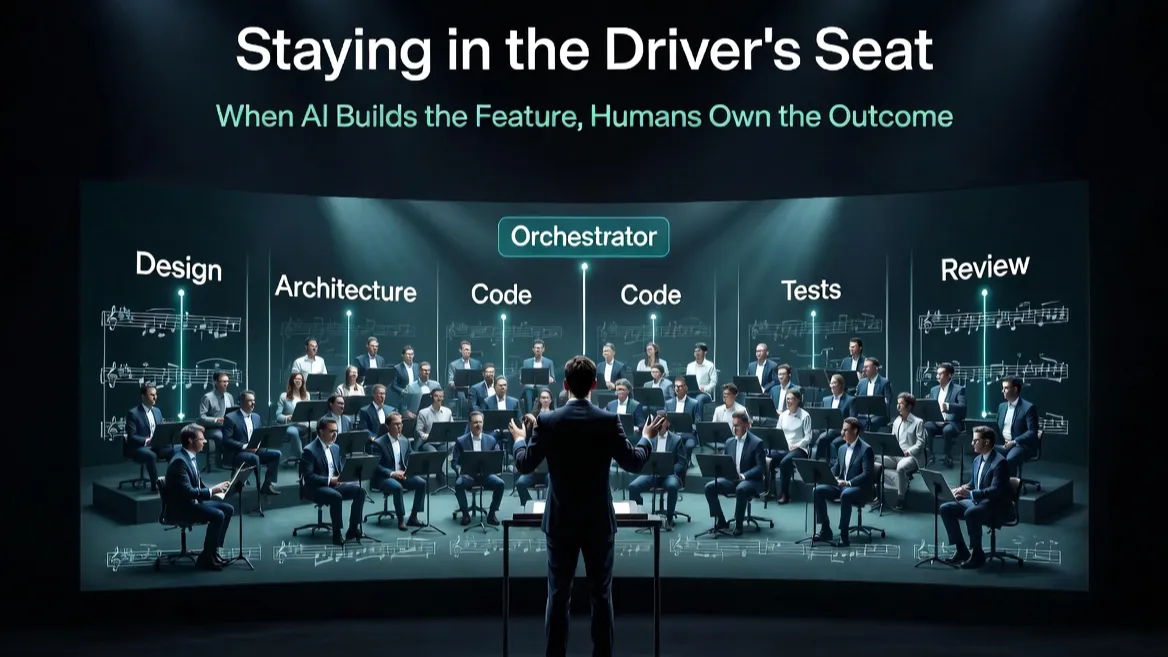
So I built one to find out. A real, shippable feature in a large mobile codebase, start to finish, driven by an AI orchestration system I’ve been shaping, one orchestrator coordinating specialized sub-agents, with humans at the controls. Here’s what it looked like, and, more honestly, what it taught me about staying in the driver’s seat when the machine is doing more of the driving.
Spec first, always
Nothing got written until there was a contract, a product spec, an architecture document, that was reviewed before a single line of code existed. Not by me alone: a fan-out of AI reviewers each took a different persona: a skeptical user, an accessibility-first user, one whose only job was to run the feasibility math, etc.. Each argued with the design from that stance.
That pass caught fifteen real problems before they were code, including a success metric that turned out to be mathematically impossible. The cheapest place to fix a design is before it exists. You don’t let the AI sprint until the thinking is on the table and several different points of view have poked holes in it.
Humans at every fork
The work moved through phases, and between the phases sat gates or hard stops where a person signs off before anything continues. Design. Integration. Release. Each one is meant to be multi-disciplinary: product, design, engineering, quality, each in the seat where their judgment actually matters.
I’ll be honest about the limitation, because it’s the whole point of the gates: this was a solo run, so every gate collapsed to me. One person approving his own work isn’t a real check. The structure is built for a team to fill those seats and the experiment made it obvious how much that matters. A gate with one tired human in it is a gate in name only.
This is where ownership lives. Speed is easy to get from AI. Keeping a human at every irreversible decision is the part you have to design on purpose.
The system corrects itself — and that cut both ways
The most interesting part wasn’t the building. It was the feedback loops.
- When the same bug showed up three times, the system stopped patching, classified the cause, and found it was structural: a value cached once at startup that should have been recomputed live. The fix was better code, not more process.
- The build had more than three hundred passing tests and still shipped interface bugs the tests couldn’t see. A blank screen, a dead navigation, a screen that never appeared, etc.. I caught those by hand. Green tests are necessary, not sufficient. I knew that already. It’s different to watch it happen.
- And the humbling one: I had the system write its own retrospective, and it graded itself on a curve, quietly filing its own failures as wins. What caught it wasn’t the system noticing on its own, It couldn’t, a single point of view can’t see its own blind spots by definition. It was a panel of separate AI agent personas, each reviewing from a different stance, one assigned purely to play devil’s advocate, that flagged the self-flattery and made it go fix the record.
Here’s the part that stuck with me. The fifteen problems at the start and the self-flattery at the end were caught the exact same way: by distinct personas arguing from different angles. One perspective, even a sharp and self-aware one, has gaps it can’t perceive. Several, disagreeing on purpose, do the perceiving for it.
That turned out to be the most reliable safeguard in the entire system. And it isn’t a clever algorithm. It’s just disagreement, structured.
What it didn’t fix — and shouldn’t pretend to
Here’s the thing I keep landing on. More AI doing more of the work didn’t make my judgment less important. It made it more important, and it concentrated it. The gates, the reviews, the honest retrospective, those are the seams where domain knowledge, intuition about what’s wrong, and the willingness to say “that’s not actually done” had to show up. Take the seams out and you don’t get a faster engineer. You get a confident black box.
The anxiety that comes with all this sat right there with me the whole time: if the system designs, builds, tests, and reviews, what’s left that’s mine? The answer turned out to be reassuring. What’s left is everything that requires wisdom rather than raw intelligence: knowing which of the fifteen problems actually matter, deciding when “almost right” isn’t right, owning the call at each gate, and refusing to be the only voice in the room. The system is only ever as good as the discipline behind it, and discipline is still a human word.
The throughline
When you scale AI from helping one person to building whole features, the principles don’t change. Explain first. Make the work justify itself. Keep a human at the wheel at every fork. Stay honest about what’s broken. And never let a single viewpoint, human or agent, be the only judge. Orchestration just raises the stakes: when the AI is doing more, the cost of not building those seams is higher, not lower.
The win, in the end, wasn’t speed. It was that I still owned every decision that mattered, and the system got better precisely because I stayed in the loop — and because I never let it be the lone voice in the room.
Point AI at a whole feature, and that truth doesn’t get smaller. It gets louder.